Germany's digital receipt obligation from 2028: what changes for retailers
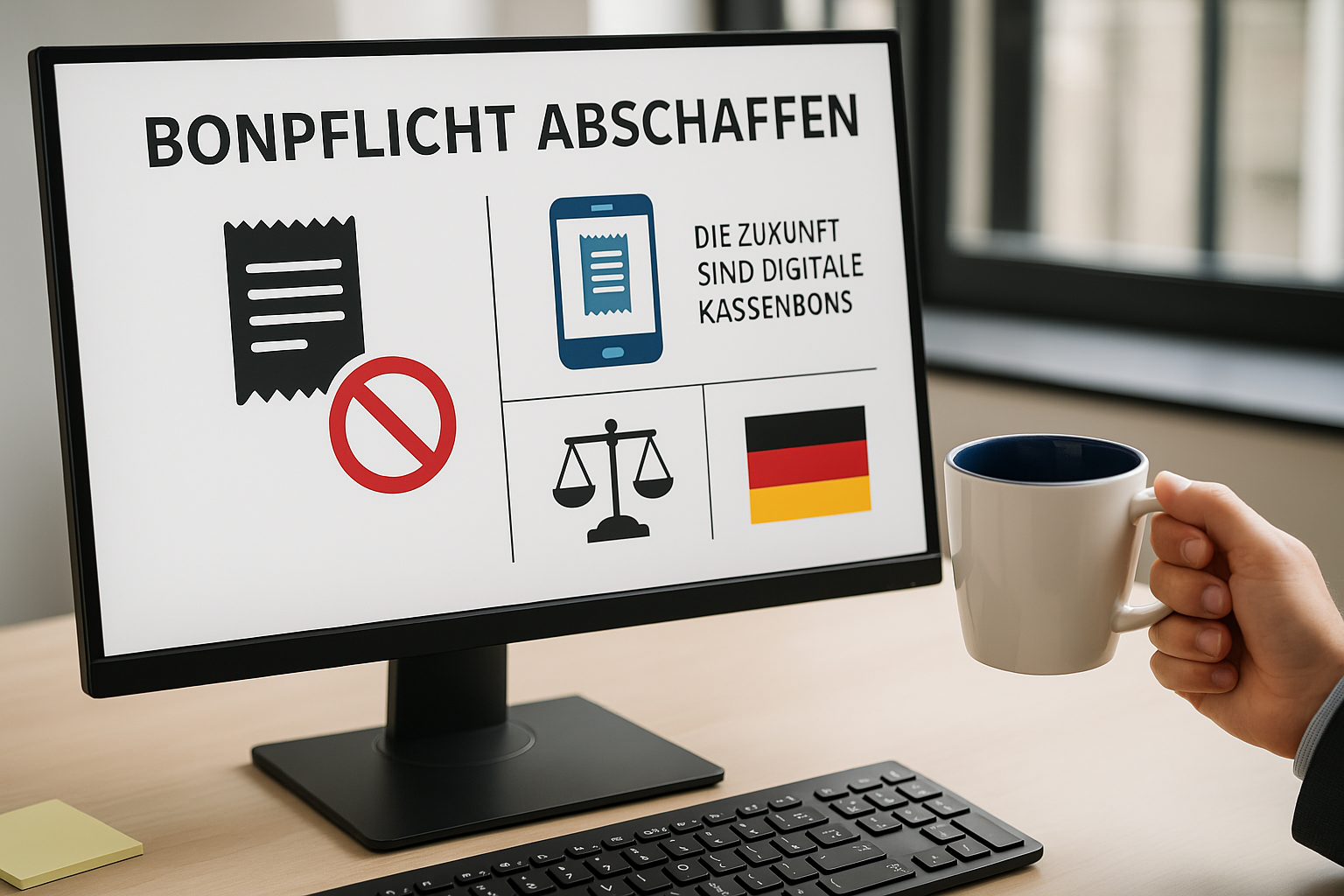
From 1 January 2028, every retailer using an electronic till in Germany must provide customers with their receipt digitally. Paper will only be issued on request. Failing to provide a receipt can carry a fine of up to 5,000 euros.
This is set out in the draft bill published by the German Federal Ministry of Finance on 7 August 2026. The coalition agreement had previously stated that the receipt obligation would be abolished. That is no longer the plan.
This article covers what currently applies, what changes in 2028, what stays the same, and what retailers should do now.
The receipt obligation in Germany: what applies today
Germany's receipt obligation has been in force since 1 January 2020. In law it is called the receipt issuance requirement and sits in section 146a (2) of the German Fiscal Code. Anyone recording taxable transactions with an electronic recording system with a till function must issue a receipt to the customer and make it available in immediate temporal connection with the transaction.
Four points are regularly confused:
- The obligation attaches to the till system, not to the sector. Businesses using an open cash drawer are so far not affected.
- Electronic delivery is already permitted today. The receipt may be provided in electronic form with the customer's consent. Paper is the norm in practice, but it is not what the law requires.
- Customers do not have to take the receipt. There is no obligation to accept one.
- Exemptions are possible, but only in individual cases of undue hardship under section 148 of the Fiscal Code, and on application to the tax office.
Breaching the receipt issuance requirement is not subject to a fine under current law. That is precisely what is set to change.
What changes from 2028
The paper-based receipt issuance requirement is replaced by an electronic receipt provision requirement (draft section 146a (2) of the Fiscal Code). Anyone recording taxable transactions must in future provide the customer with an electronic receipt in a standardised data format, in immediate temporal connection with the transaction.
The route to that is expressly technology-neutral. The draft itself names several options:
- QR code on the till's customer display
- Download link
- Near Field Communication (NFC)
- Direct delivery into a customer account
The draft sets no technical requirement as to which route must be chosen. Each retailer decides. The explanatory memorandum names the QR code on the till display as the most practical solution, because customers can scan it without installing a shop-specific app.
What stays the same
- Paper on request remains. The right to a receipt under section 368 of the German Civil Code continues to apply.
- Customers need not accept anything. No obligation to take a receipt is created.
- Businesses without an electronic till are not affected by the provision requirement.
New: fines of up to 5,000 euros
A breach of the receipt provision requirement can be penalised with up to 5,000 euros (draft section 379 (2) no. 2 in conjunction with (4) of the Fiscal Code).
The existing paper-based receipt issuance requirement carries no such penalty. This is the most significant practical tightening in the draft: the obligation is not new, but for the first time it has teeth.
The till requirement above 100,000 euros in revenue
In parallel, a till requirement is being introduced (draft section 146b (1) of the Fiscal Code). Businesses with more than 100,000 euros in total annual revenue must use an electronic recording system. The open cash drawer ceases to be an option for them.
The draft estimates around 114,800 affected tills.
Press coverage cites both 2027 and 2028 as the start date. The governing provision is the application rule in draft article 101a (2) of the Introductory Act to the Fiscal Code, which refers to periods after 31 December 2027.
On the cost question
The draft accounts for the measures separately. The move to digital receipts relieves businesses by 130.3 million euros annually. The till requirement burdens them with 30.3 million euros, further measures with 11.1 million euros. The net effect is minus 88.9 million euros per year.
On the draft's own figures, then, it is not the digital receipt that creates the burden but the till requirement introduced alongside it.
Frequently asked questions
When will the receipt obligation be abolished?
It will not. From 1 January 2028 the obligation to issue on paper falls away. The receipt obligation itself remains and is met digitally.
Since when has the receipt obligation applied in Germany?
Since 1 January 2020, in law as the receipt issuance requirement under section 146a (2) of the Fiscal Code.
Is a till receipt mandatory?
The retailer must provide it. The customer does not have to take it.
Does the receipt obligation apply to bakeries?
Yes, as soon as an electronic till is in use. The obligation attaches to the till system, not to the sector.
What retailers should do now
- Check whether the existing till system can provide digital receipts.
- Clarify who handles provision: the till system or a specialist provider.
- Avoid buying new equipment under time pressure while the data format and the implementing regulation remain open.
The consultation with industry associations ran until 13 August 2026. Cabinet decision, Bundestag and Bundesrat are still outstanding. This is a draft, not law in force.
About anybill
anybill makes till receipts digital. More than 90 software and MarTech partners in the DACH retail market use our interface, from hypermarkets and drugstores to fuel retail. The receipt is provided via a QR code on the customer display, without customers needing to install a retailer-specific app. Integration runs through the existing till system, in most cases without new hardware.
That satisfies the obligation. What comes after is the more interesting part: the receipt becomes a post-purchase touchpoint. Customer accounts, returns without a paper receipt, integration with existing loyalty programmes, and analysable purchase data for personalisation and retail media. We process over 100 million receipt records per month.
Want to know what the receipt provision requirement means specifically for your till system? Talk to your POS provider or directly to our team. We will look at your system landscape and tell you honestly what needs doing and what does not.
Arrange a conversation
Status: August 2026. Source: draft bill of the German Federal Ministry of Finance dated 7 August 2026.
Weitere Blogbeiträge