E-invoicing in retail: what matters now and how retailers and POS providers stand to benefit
Since January 1, 2025, e-invoicing has been mandatory for B2B transactions between companies based in Germany. Even so, there is still plenty of uncertainty among retailers and POS providers: Which cases are affected? What has to be implemented technically? And how can these new requirements be integrated into existing processes?
What applies and what doesn't?
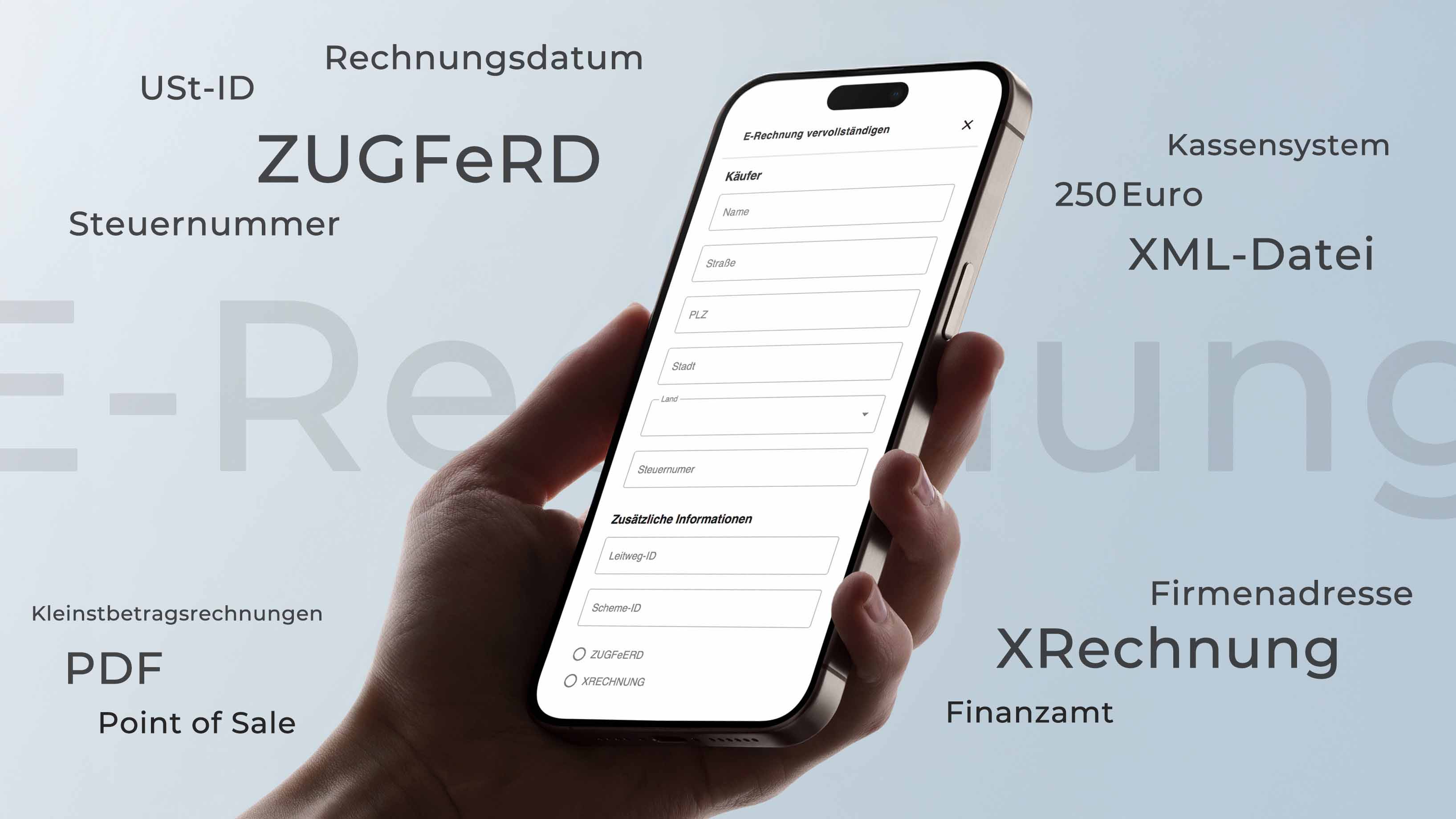
The e-invoicing mandate covers all B2B transactions above €250 between companies based in Germany. Small-value invoices up to this threshold are exempt, but there are plenty of situations in which the threshold is exceeded or in which customers explicitly request an e-invoice. In such cases, a simple PDF is no longer enough. The invoice must be provided in a structured, machine-readable format such as XRechnung or ZUGFeRD.
What must an e-invoice contain?
A valid e-invoice requires certain mandatory details:
- Name and address of the invoice issuer and recipient
- Tax number or VAT ID
- Invoice date and consecutive invoice number
- Description of the goods or services
- Net amount, VAT, and gross amount – broken down by tax rate
Important: these details must be available in structured form, e.g. as an XML file, so that they can be processed automatically.
Challenges at the point of sale and what POS providers need to know now
Many POS systems are not prepared to issue e-invoices directly. Processes at the point of sale (POS) are designed for speed and simplicity. Generating a legally compliant invoice with XML data, capturing customer details, and making no mistakes along the way? That takes flexible solutions that start at the right point.
How anybill solves this: issuing e-invoices at the checkout
anybill already makes it possible to issue digital receipts with the existing POS system today. Building on this, we are working with our POS software partners to extend our solution to cover the requirements of the B2B e-invoicing mandate – without breaks in the digital process and without isolated stand-alone solutions:
- A new receipt type, e-invoice, alongside existing receipt types such as the hospitality receipt
- Entry of extended customer details via the receipt retrieval page
- Output in XML or ZUGFeRD format with a matching PDF view
- Subsequent addition of missing details – e.g. VAT ID or company address – directly by the customer
- In the future, also with the option of transmission to the tax office
All of this happens in close connection with the POS system, with no additional breaks in the digital process and no manual rework. Receipts remain digital, complete, and legally compliant.
Can a receipt be issued digitally and completed later?
Yes, that is possible – and often the best solution. A digital receipt can initially be created anonymously and then completed with the necessary details via the receipt retrieval page. From this, an e-invoice in ZUGFeRD format is generated automatically. The combination of PDF and XML means that both people and machines can work with it. What matters is that these details are added promptly after the transaction. Only then does it stay clean for tax purposes.
What about transmission to the tax office?
There is currently no obligation in Germany to transmit every e-invoice to the tax office automatically. That could change, however, as part of the EU-wide “VAT in the Digital Age” package. Even now, it makes sense to rely on future-proof formats that make later reporting technically possible.
Conclusion
anybill is the partner for digital receipts in retail – whether B2C or B2B. Our solution was built for the point of sale, and that is exactly where we start: we are extending the existing digital receipt so that it meets the requirements for e-invoicing and can also be used in a B2B context. As with the hospitality receipt, this does not create an additional process but a logical extension – seamlessly integrated into the POS system. What we offer is not a standalone e-invoicing solution but an evolution of the digital receipt that is legally compliant, flexible, and future-proof.
Weitere Blogbeiträge