EV charging explained: payment options, the receipt mandate, and the right solution for operators and retailers
Charging infrastructure is expanding rapidly in Germany and across Europe. With AFIR and the German Charging Station Ordinance (LSV), uniform rules have recently come into force, creating clear obligations for operators.
One point is especially important: anonymous customers must also be able to charge and pay – entirely without an app or registration. That calls for low-barrier payment options such as Girocard, credit card, or QR code. At the same time, the receipt mandate (Bonpflicht) applies – and this is exactly where traditional solutions with paper printers quickly reach their limits. Digital receipts are therefore becoming the key to a legally compliant and smooth process at AC and DC charging stations.
Why EV charging matters so much for retailers and operators
Electromobility has long since stopped being a niche topic. Charging points are now standard equipment at modern locations – whether at the supermarket, at the fuel station, or in the company parking lot. For operators, this means implementing new regulations while ensuring a positive customer experience. The GEIG in particular adds extra pressure: for new builds or renovations of buildings with parking spaces, charging points are a mandatory part of the planning.
For retailers, this is an opportunity: those who offer charging points gain additional dwell time at their location – time that can be deliberately linked with shopping.
From closed systems to open payment options
In the early days of EV charging, charging was often tied to apps or dedicated customer cards. Today, the EU's AFIR regulation demands much more open access. Users must be able to pay spontaneously, without complications, and without registering first. Payment terminals or QR code solutions make this possible. For operators, this means new investments, as existing charging stations need to be retrofitted.
One rule to note: DC chargers with a charging power of 50 kW or more are required to provide a payment terminal – a QR code solution is not sufficient here. And that means the terminal must also be able to issue a receipt, in a way that works without paper.
Digital receipts as the standard at the charging point
A printer inside the charging station is expensive, maintenance-intensive, and error-prone. Digital receipts are therefore the obvious solution. There are several ways to make the process work for customers.
The simplest is a dynamic QR code that is generated for each charging session and shown directly on the display. Alternatively, a receipt finder with a static link can be used, although approval from the authorities has to be taken into account here. The third option is entering an email address directly at the charging station so that the receipt is delivered immediately.
All three approaches meet the legal requirements and make the charging session transparent and traceable for the user.
Who is active in the market and what they are aiming for
The operators of the charging infrastructure are known as CPOs. They provide the charging stations along motorways, at fuel stations, or at supermarkets, and take care of operation and billing. Retailers, in turn, pursue a different goal: they want to bring customers into their stores during the charging session and generate additional revenue there.
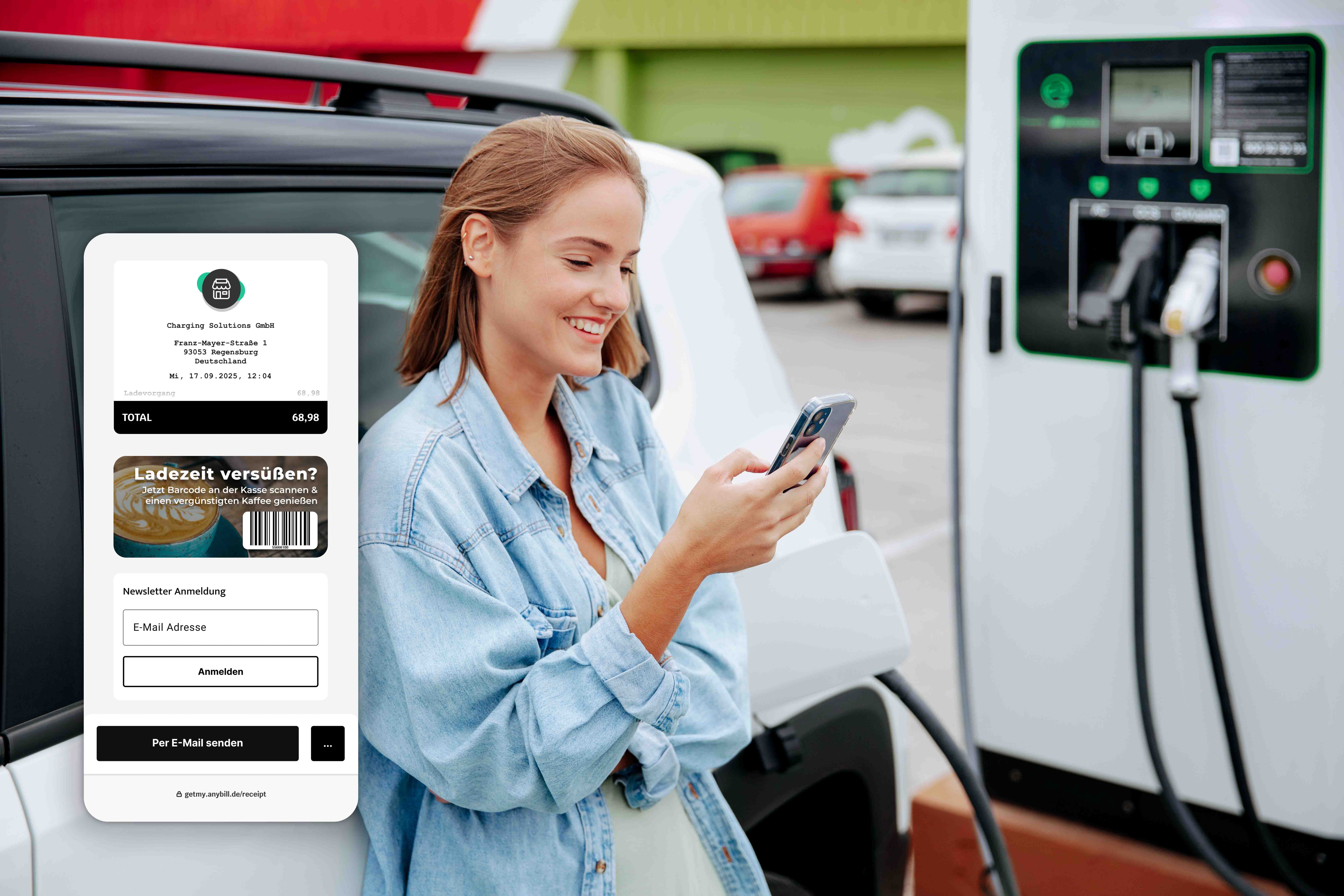
A digital receipt can do more than just satisfy the legal requirements – it becomes a marketing tool. Discounts or coupons can be attached directly to the receipt, making time spent at the location even more attractive.
Technical foundations for a reliable integration
Legal certainty is essential in charging. The OCMF token serves as proof that a charging session was carried out in compliance with calibration law. anybill provides this proof directly in the digital receipt. Communication between the charging station and the backend runs via OCPP, while in the payment environment, protocols such as ZVT or OPI are key.
For operators, this means a solution must slot seamlessly into existing systems without creating additional complexity.
Two typical processes – depending on the customer
For known customers, who are identified via an account or Plug and Charge, the receipt can be linked directly to their account. The structured data is sent to the API, the receipt is created and added to the customer account. The user then manages it conveniently on the web or in the app.
For anonymous customers, it works without an account. After charging, an individual receipt is generated and displayed as a QR code. The user scans it right away or retrieves the receipt later via the receipt finder, entering verified parameters such as amount, date, and card details, or using a six-digit code from the display. That way, the receipt remains traceable and legally retrievable at any time.
Economic significance and potential at the location
A charging station generates fewer transactions than a checkout, but strategically, charging points are hugely important. They create reach and dwell time. Anyone charging usually has a few minutes to spare – and that time can be used deliberately to bring customers into the store.
Digital receipts open up new possibilities here: they serve not only as proof but also as advertising space for coupons and offers. Conversely, a discount on the store receipt can make the next charging session cheaper. This creates a cycle that meaningfully connects retail and the charging point.
The challenges operators need to solve
The biggest hurdle is the diversity of the market. Different hardware, proprietary systems, and complex integrations make uniform solutions difficult. On top of that come strict regulatory requirements and country-specific differences.
User experience is an issue too: many drivers complain about a lack of price transparency or limited payment options. This is exactly where anybill comes in – standardizing receipt issuing, securing it under calibration law, and integrating it into existing interfaces.
A look ahead
Charging infrastructure will keep growing – not only along motorways but also in residential complexes, at companies, and in shopping centers. Smart charging, load management, and vehicle-to-grid bring additional requirements.
At the same time, new billing models with dynamic pricing and subscription solutions are emerging. For all of this to work, it takes standardized interfaces and a receipt system that adapts flexibly. Digital receipts are the logical standard for that.
Conclusion
EV charging is more than just a charging point for electricity. It is a strategic topic for retailers and operators, bringing together regulation, technology, and customer experience. The receipt mandate makes digital solutions indispensable.
anybill delivers the right answer: a legally compliant digital receipt layer that integrates into existing systems, provides the OCMF token, and at the same time opens up new touchpoints for marketing and customer loyalty. Those who adopt digital receipts today not only meet the requirements – they also create a convincing experience for customers and clear added value for the location.
- Why EV charging matters so much for retailers and operators
- From closed systems to open payment options
- Digital receipts as the standard at the charging point
- Who is active in the market and what they are aiming for
- Two typical processes – depending on the customer
- The challenges operators need to solve
- Conclusion
Weitere Blogbeiträge