Customer segmentation in retail: how to do it without a data science team
Customer segmentation sounds like corporations, algorithms and data scientists. The reality: even with limited resources, you can group your customers in a meaningful way and address them with purpose. This article presents four methods that work without a specialist team.
What customer segmentation really means
Segmentation means dividing customers into groups that share similar characteristics or behaviors. The goal is simple – instead of treating every customer the same, you address different groups differently. The newsletter for frequent shoppers looks different from the one for occasional customers. The promotion for price-conscious shoppers looks different from the one for quality buyers.
This is not a new concept. Every experienced salesperson does it intuitively: they recognize a regular and treat them differently from a first-time visitor. Segmentation systematizes that knowledge – and makes it scalable.
Why customer segmentation is becoming more important now
Three developments are making segmentation relevant for mid-market companies as well:
The tools are more accessible. What once required complex statistics software can now be done in Excel or with specialized platforms that deliver results at the click of a button.
The data is already there. Loyalty cards, digital receipts, newsletter sign-ups – each of these touchpoints produces data that can be used for segmentation.
Expectations are rising. Customers are used to personalized communication from Amazon and others. One-size-fits-all messaging increasingly feels arbitrary.
Four methods of customer segmentation in retail
There are many ways to segment customers. The following four methods have proven themselves in retail and can be implemented without data science expertise.
Method 1: RFM analysis
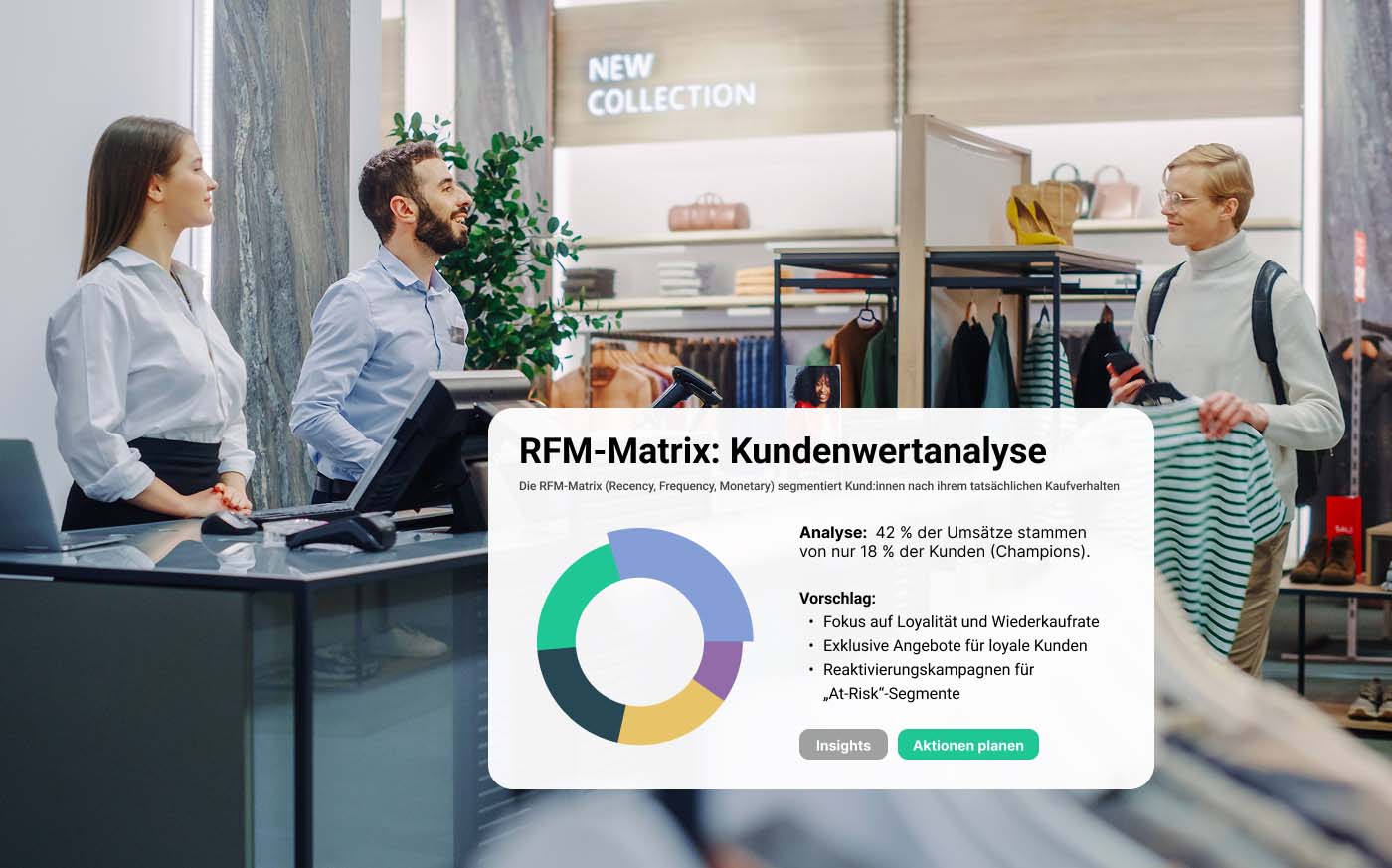
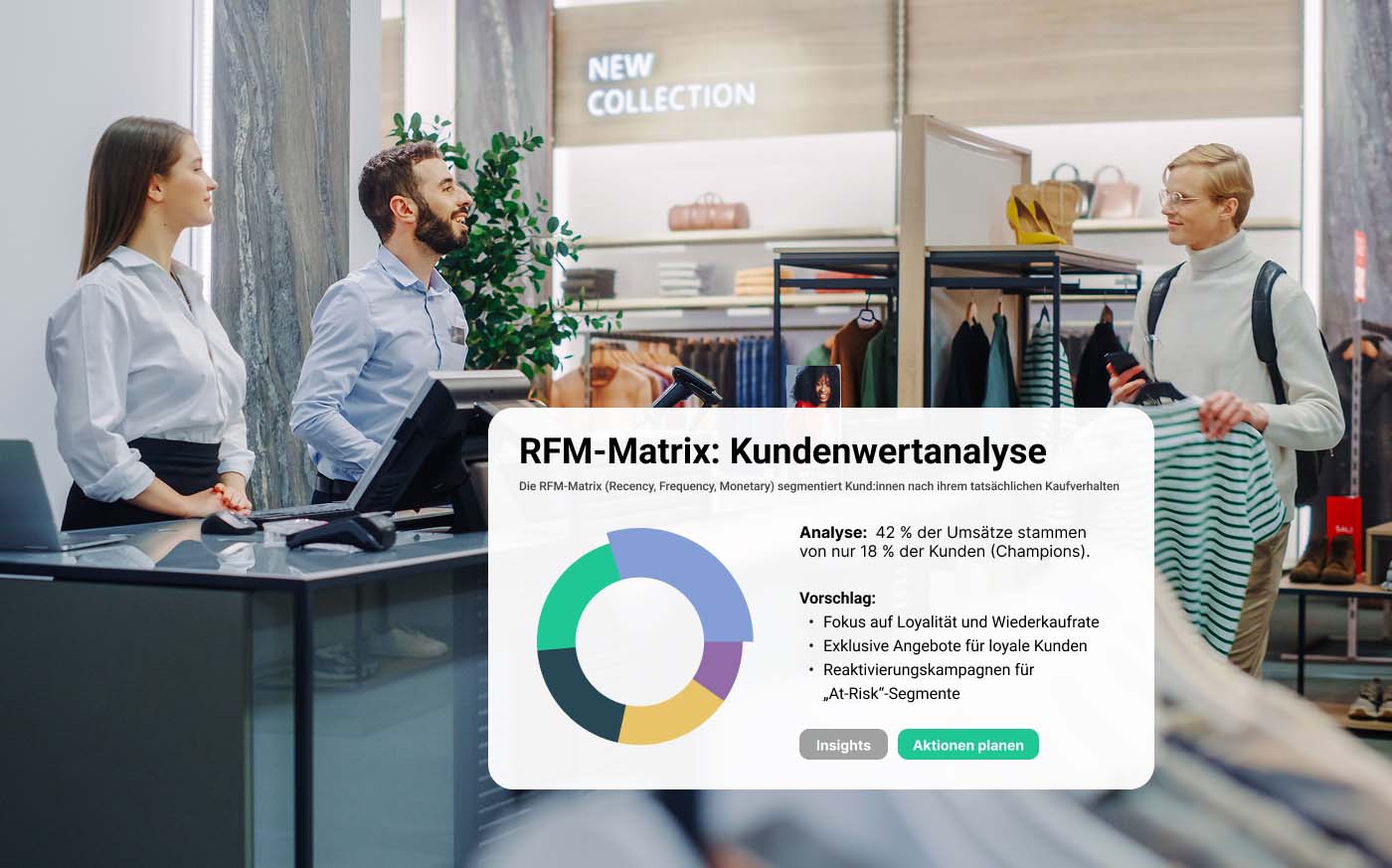
RFM stands for Recency, Frequency, Monetary – in other words: how recently did the customer buy? How often do they buy? How much do they spend? These three dimensions are enough to divide customers into meaningful groups.
The method is as simple as it is effective. A customer who shopped for the tenth time a week ago and spent €200 is clearly more valuable than someone who came once six months ago and spent €20.
How it works:Score each customer on a scale of 1–5 for R, F and M. Combine the scores into segments. A customer with 5-5-5 is your champion. A customer with 1-1-1 is effectively lost.
Typical RFM segments:
- Champions (5-5-5)
- Loyal customers (X-5-X)
- Potential champions (5-X-X)
- At risk (2-5-5)
- Hibernating (1-3-3)
- Lost (1-1-1)
Practical tip: Start with just three segments: top customers, the middle, and reactivation candidates. That is easier to manage than ten different groups.
Method 2: Basket-based segmentation
What does the customer buy? This question leads to entirely different segments than RFM analysis. An organic shopper differs from a bargain hunter, even if both shop equally often and spend the same amounts.
Basket-based segmentation groups customers by their product preferences. A DIY store might distinguish between professional tradespeople, hobby DIYers and garden enthusiasts. A drugstore might distinguish between natural cosmetics fans, price-conscious shoppers and brand shoppers.
How it works:Define categories or product groups that matter for your business. Analyze which categories each customer prefers. Cluster by dominant preferences.
Grocery retail example: The customer buys 60% organic products and 80% fresh goods. They belong in the "quality- and freshness-oriented" segment – not in the "convenience" segment, despite the occasional ready meal.
Practical tip: Start with the most obvious distinctions in your sector. In fashion retail: womenswear vs. menswear vs. childrenswear. In DIY: garden vs. workshop vs. renovation.
Method 3: Behavior-based segmentation
When does the customer buy? How do they respond to promotions? Do they use the app or the newsletter? These behavior patterns show how best to reach the customer.
Some customers only buy when there is a discount, others ignore promotions. Some open every newsletter, others signed up only for a voucher. Some always come on Saturdays, others only on weekdays. These differences are gold for targeting.
How it works:Track relevant behaviors: response to promotions, preferred shopping days, channel usage. Group by dominant patterns.
Typical behavior segments:
- Deal hunters – only buy at a discount
- Regulars – come weekly at the same time
- Digital natives – actively use the app and newsletter
- Traditional shoppers – buy exclusively in store
Practical tip: Start by analyzing coupon redemption rates. They immediately show which customers are price-sensitive – and which are not.
Method 4: Value-based segmentation
How profitable is the customer? The question sounds sober, but it is commercially decisive. Not all revenue is equally valuable. A customer who only buys promotional goods at a minimal margin is less profitable than one who regularly takes full-price items.
Value-based segmentation divides customers by their contribution margin or customer lifetime value. It requires a little more data, but it delivers the most commercially relevant view.
How it works:Calculate the margin per customer – either exactly or approximately via product categories. Rank customers by profitability. Split them into deciles or quintiles.
Typical insight: The top 20 percent of customers often generate 80 percent of the contribution margin. This group deserves particular attention and care.
Practical tip: If you do not have exact margins per transaction: categorize products as high-margin, medium and low. That is enough for a first approximation.
The four methods compared
MethodData requiredEffortBest useRFMPurchase date, frequency, revenueLowCustomer loyalty, reactivationBasket-basedItem and category dataMediumAssortment, cross-sellingBehavior-basedChannel usage, promotion responseMediumCampaign targetingValue-basedMargin or CLV estimateHigherResource allocation
Practical examples by sector
Grocery retail
A regional supermarket segments its loyalty card holders into four groups: weekly shoppers who do the big shop on Saturdays. Convenience shoppers who pick up small amounts every day. Organic-focused shoppers with a high share of ecological products. Price-conscious shoppers with an above-average private-label share.
Each group receives tailored coupons: the weekly shopper gets a discount from €50, the convenience shopper gets one on ready meals.
DIY store
A DIY chain distinguishes four segments: professional tradespeople with regular large orders. Project buyers who come once a year for a renovation. Garden enthusiasts with a seasonal focus. Small-item buyers who come frequently for low amounts.
The communication is adapted: the professional gets a personal contact and volume discounts. The project buyer gets planning support and complete solutions.
Fashion retail
A fashion retailer segments by style preference and buying behavior: trend followers who buy new collections. Classic shoppers who prefer timeless basics. Sale buyers who only strike when prices are reduced. Premium customers with a high average receipt.
The invitation to the VIP event goes to the premium group. The sale newsletter – only to those who respond to it.
Five starter segments for every retailer
Want to start tomorrow? Begin with these five segments, which work in almost every sector:
SegmentCriterionRecommended actionChampionsTop 10% of revenue, activeVIP program, exclusive eventsRegular customersRegular, solid revenueLoyalty program, upsellingNew customersFirst purchase < 90 daysWelcome series, second-purchase incentiveAt riskNo purchase for 3–6 monthsReactivation campaign, couponInactiveNo purchase for > 12 monthsWin-back or clean-up
Tools for implementation
You do not need expensive software to get started. The choice of tool depends on your data volumes and ambitions:
Excel or Google Sheets – Entirely sufficient for up to several thousand customers. RFM scoring can be mapped with formulas, and pivot tables help with the analysis.
CRM systems – Most modern CRMs have built-in segmentation features. Salesforce, HubSpot, Pipedrive and others offer scoring and filtering options.
Specialized analytics platforms – Solutions such as Purchase Intelligence connect directly to the POS system and deliver segmentations automatically, including recommended actions.
Email marketing tools – Mailchimp, Klaviyo and similar tools offer behavior-based segmentation based on open and click rates.
Conclusion: starting matters more than perfecting
Customer segmentation does not have to be complicated. Start with a simple method – for example RFM with three groups. Test different messages for different segments. Measure the results. Refine.
The biggest mistake is not the wrong method. The biggest mistake is to keep treating all customers the same when you already have the data to do better.
Your customers are not all the same. Stop treating them as if they were.
Your checklist for getting started
How to get started in one week:
- [ ] Day 1: Export customer data from the last 12 months
- [ ] Day 2: Calculate RFM scores (last purchase, frequency, revenue)
- [ ] Day 3: Assign customers to 5 starter segments
- [ ] Day 4: Define one action per segment
- [ ] Day 5: Launch the first campaign for one segment
Customer segmentation automatically – with Purchase Intelligence
anybill Purchase Intelligence makes customer segmentation automatic. The platform analyzes transaction data, identifies customer groups and delivers recommendations for targeting. No Excel acrobatics, no data science skills required.
Weitere Blogbeiträge