Hospitality receipts in Germany: the new rules since 2025
Germany's Federal Ministry of Finance has rewritten the rules for substantiating business entertainment expenses. The circular of 19 November 2025 (IV C 6 - S 2145/00026/005/033) replaces the previous one of 30 June 2021. Anyone completing a hospitality receipt (Bewirtungsbeleg) according to older guidance risks the tax office disallowing the deduction entirely.
The trigger for the revision is the mandatory e-invoice in German domestic B2B transactions, in force since 1 January 2025. The ministry had to clarify how an electronic invoice relates to a till receipt from a restaurant. For entertainment up to 31 December 2024, the earlier version still applies.
This article covers what belongs on the self-issued voucher, what the restaurant's invoice must contain, and the two points at which the deduction typically fails in practice.
What belongs on the self-issued voucher
The hospitality receipt in the narrow sense is an informal document you write yourself. Section 4 (5) sentence 1 no. 2 of the German Income Tax Act requires four pieces of information:
- Place of the entertainment
- Date of the entertainment
- Participants, including yourself
- Purpose of the entertainment
- Amount of the expenses
Two points are regularly overlooked. The voucher must be created promptly, not weeks later when travel expenses are filed (Federal Fiscal Court, 25 March 1988, III R 96/85). And it must be signed (Federal Fiscal Court, 15 January 1998, IV R 81/96).
A generic description of the purpose is not enough. Entries such as “business lunch” or “working meal” fail the requirement because they do not establish a concrete business connection. What matters is the substance of what was discussed.
If the entertainment takes place in a restaurant, the voucher only needs the purpose and the participants. The restaurant's invoice must be attached.
What the restaurant's invoice must show
Here the ministry distinguishes by invoice amount. Up to 250 euros the document is a small-value invoice under section 33 of the German VAT Implementing Regulation, for which fewer details are required.
Every hospitality invoice must show:
- Name and address of the hospitality business
- Date of issue
- A description of the service with quantity and type of food and drinks
- Date of the entertainment
- Invoice amount
From 250 euros, three items are added: the tax number or VAT identification number of the business, a sequential invoice number, and the name of the taxpayer hosting the meal.
Two details decide acceptance or rejection in practice. A blanket entry of “food and drinks” with a single total is not sufficient. Descriptions such as “menu 1” or “dish of the day 2” are permitted. For the date of supply, a reference such as “date of supply equals invoice date” is acceptable, while handwritten additions and date stamps are explicitly not.
Where most receipts fail
If the hospitality business uses an electronic recording system with a till function under section 146a (1) of the German Fiscal Code, only invoices that are machine-generated, electronically recorded and secured by a certified technical security device (TSE) are accepted.
The consequence is severe. Handwritten invoices, or receipts that are machine-printed but not TSE-secured, mean the entertainment expenses are excluded from the business expense deduction entirely. Not reduced proportionally, but disallowed in full.
A compliant receipt is recognisable by the transaction number, the serial number of the recording system, or the serial number of the security module. These may also appear as a QR code. Anyone receiving such a receipt may, according to the ministry, rely on the invoice having been properly created and recorded.
If the security device fails, the till system may continue operating. The failure must then be visible on the receipt, for instance through a missing transaction number or another clear marker.
What the 2025 circular introduced
Three changes matter in practice.
Till receipt and e-invoice combined
For amounts above 250 euros, the business may first issue a till receipt and subsequently correct it with an e-invoice. This solves a real problem, because the host's name is often not known at the moment of payment.
The invoice may arrive digitally
Both an e-invoice under section 14 (1) of the German VAT Act and another invoice in electronic format are permitted. A paper invoice may be digitised. The self-issued voucher may also be created or digitised electronically, with authorisation via an electronic signature or approval that cannot subsequently be altered without documentation.
Linking the two documents is the new sticking point
The voucher and the hospitality invoice must be connected. What is new is that a simple reference from the voucher to the invoice or till receipt is sufficient, and that an electronic link is permitted, for example through a unique index, a barcode or a document management system. Separate storage is also allowed, with the invoice held digitally and the voucher on paper, provided the one-to-one assignment is guaranteed.
Next to it stands the sentence that matters: if no hospitality voucher can be assigned to a hospitality invoice, the business expense deduction must be refused. Responsibility for this rests explicitly with the taxpayer.
Deductible amount, tips and entertainment abroad
Business or internal? The distinction determines how much is deductible. For a business purpose, meaning the entertainment of business partners, 70 percent of reasonable expenses are deductible. The remaining 30 percent do not reduce profit. Where only the company's own employees are entertained for internal reasons, the costs are 100 percent deductible.
Input VAT. The VAT shown on the invoice is fully deductible for a business entitled to input VAT recovery, independent of the 70 percent limit on business expenses.
Tips. Where a tip is not shown separately on the invoice, the burden of proof lies with the host. Evidence can be provided, for instance, by having the recipient acknowledge the tip on the invoice.
Abroad. In principle the same requirements apply. If it can be credibly demonstrated that a machine-generated and electronically recorded invoice was not obtainable, the foreign invoice is sufficient by way of exception. Where only a handwritten invoice exists, it must be credibly demonstrated that the country in question imposes no obligation to issue machine-generated receipts.
Frequently asked questions
Is the till receipt enough on its own?
No. The till receipt or restaurant invoice evidences the cost but does not replace the details on purpose and participants. Both together form the substantiation, and the two must be assignable to one another.
What happens with a handwritten invoice?
If the business uses an electronic till, the expenses are excluded from deduction entirely. Exceptions apply abroad where it can be credibly shown that no obligation to issue machine-generated receipts exists.
What applies up to 250 euros?
Up to 250 euros a small-value invoice under section 33 of the VAT Implementing Regulation is sufficient. Tax number, sequential invoice number and the host's name are then not required. A receipt from a TSE-secured till system already meets these requirements.
Does the voucher have to be signed?
Yes. For a digital or digitised voucher, an electronic signature or approval takes the place of the handwritten one, provided it cannot subsequently be changed without documentation.
Why this matters to hospitality businesses
Seen from the restaurant's side the picture looks different, and it is rarely told this way. Whether a guest can deduct their costs depends on the quality of the receipt the restaurant issues: on the security device, on the description of items on the receipt, and on whether an invoice bearing a name can be supplied for amounts above 250 euros.
On top of that comes a physical problem. Thermal paper fades, sometimes within months. A receipt that is no longer legible at the time of an audit helps no one, however correctly it was created.
For hospitality businesses, issuing receipts is therefore less an administrative duty than a service that helps determine whether business customers come back. How the receipt obligation is shifting overall is covered in the article on the digital receipt provision requirement from 2028.
The digital hospitality receipt
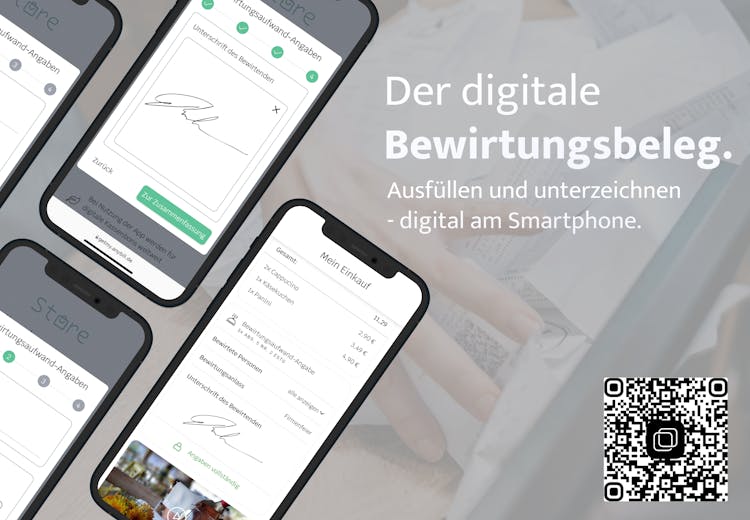
Where a restaurant has embedded anybill into its existing till system, staff select at the till that a hospitality receipt should be issued. The guest scans the QR code on the customer display and the receipt opens on their smartphone.
The restaurant's name and address, the date, the items and the prices are already populated. What remains to be filled in are the details only the guest can supply: the invoice recipient, the host and the people entertained, the purpose of the entertainment, and the signature. The receipt is created electronically, stays legible, and can be linked to the voucher through a unique identifier, exactly as the ministry has expressly permitted since November 2025.
About anybill
anybill is the real-time data infrastructure for physical retail, connecting POS, payment and more than 90 software and MarTech systems plug and play. Over 60 till systems are integrated, from hypermarkets and drugstores to hospitality. The receipt is delivered via a QR code on the customer display, without guests needing to install an app. Integration runs through the existing till system, in most cases without new hardware.
That covers receipt delivery. What comes after is the more interesting part: the receipt becomes a post-purchase touchpoint. Customer accounts, returns without a paper receipt, integration with existing loyalty programmes, and analysable purchase data for personalisation and retail media. More than 450 retailers work with anybill today, and we process over 100 million receipt records per month.
Want to know whether your till system can issue digital hospitality receipts? Talk to your POS provider or directly to our team. We will look at your system landscape and tell you what needs doing and what does not.
Arrange a conversation
This article does not constitute tax advice. For an assessment of your individual case, please consult your tax adviser. Source: German Federal Ministry of Finance, circular of 19 November 2025, IV C 6 - S 2145/00026/005/033.
Weitere Blogbeiträge