AI in retail: more than a buzzword

Five use cases that work today
Artificial intelligence is changing retail – but differently than the headlines suggest. While large corporations invest billions in autonomous stores, mid-market retailers are asking: what does AI really deliver? A reality check beyond the hype.
The status quo: between vision and reality
Reading about AI in retail today, you quickly get the impression that brick-and-mortar retail is on the verge of a revolution. Checkout-free supermarkets, robots in the aisles, personalized price tags that adjust in real time. Reality looks different.
In most German retailers' stores, Excel still rules. Assortment decisions are based on gut feeling and experience. Customer behavior is captured through loyalty cards at best – and their data lies dormant in silos. That is not a criticism; it is a reality that has grown over time.
The good news: this is exactly where the opportunity lies. While Amazon and Walmart spend billions on experimental technologies, mid-market retailers can achieve real competitive advantages today with manageable effort. Not through science fiction, but through practical applications that have already proven themselves.
AI hype vs. AI reality: a comparison
Before we dive into the concrete use cases, it is worth taking a sober look at the industry's promises – and how much of them can actually be implemented today.
Data analysis
The hype: AI analyzes everything automatically
The reality: AI needs structured data and clearly defined questions
Personalization
The hype: every customer receives individual offers in real time
The reality: meaningful segmentation works; 1:1 personalization is complex
Forecasts
The hype: AI predicts the future
The reality: AI recognizes patterns and calculates probabilities
Implementation
The hype: plug & play within days
The reality: data integration takes preparation; after that, fast results are possible
Costs
The hype: affordable only for large corporations
The reality: scalable SaaS models make AI accessible to mid-market companies
Expertise
The hype: requires a team of data scientists
The reality: modern tools can be used by business users without coding skills
This comparison shows that the most effective AI applications are often the unspectacular ones. They do not replace employees – they make their work more effective. They do not require huge volumes of data; they use information that is generated anyway, above all transaction data.
Five use cases that work today
The following five scenarios are not a distant vision. Mid-market retailers are already using them successfully – with measurable results.
1. Intelligent market basket analysis: understanding what sells together
Every transaction tells a story. A DIY store customer buys paint, brushes, and protective sheeting – but no roll of masking tape? A fashion customer takes the dress but not the matching shoes? Spotting these connections used to be the job of experienced store managers. Today, algorithms handle this analysis – faster and more comprehensively.
What the AI delivers
Machine learning identifies product affinities across millions of transactions. The result: data-based recommendations for cross-selling, optimized shelf placement, and targeted discount campaigns.
Practical example
A drugstore chain analyzed its transaction data and found that customers who buy certain natural cosmetics products are far more likely than average to have organic snacks in their basket. That insight led to a redesign of shelf adjacencies – with an eight percent revenue increase in the category.
2. Customer segmentation without a data science team
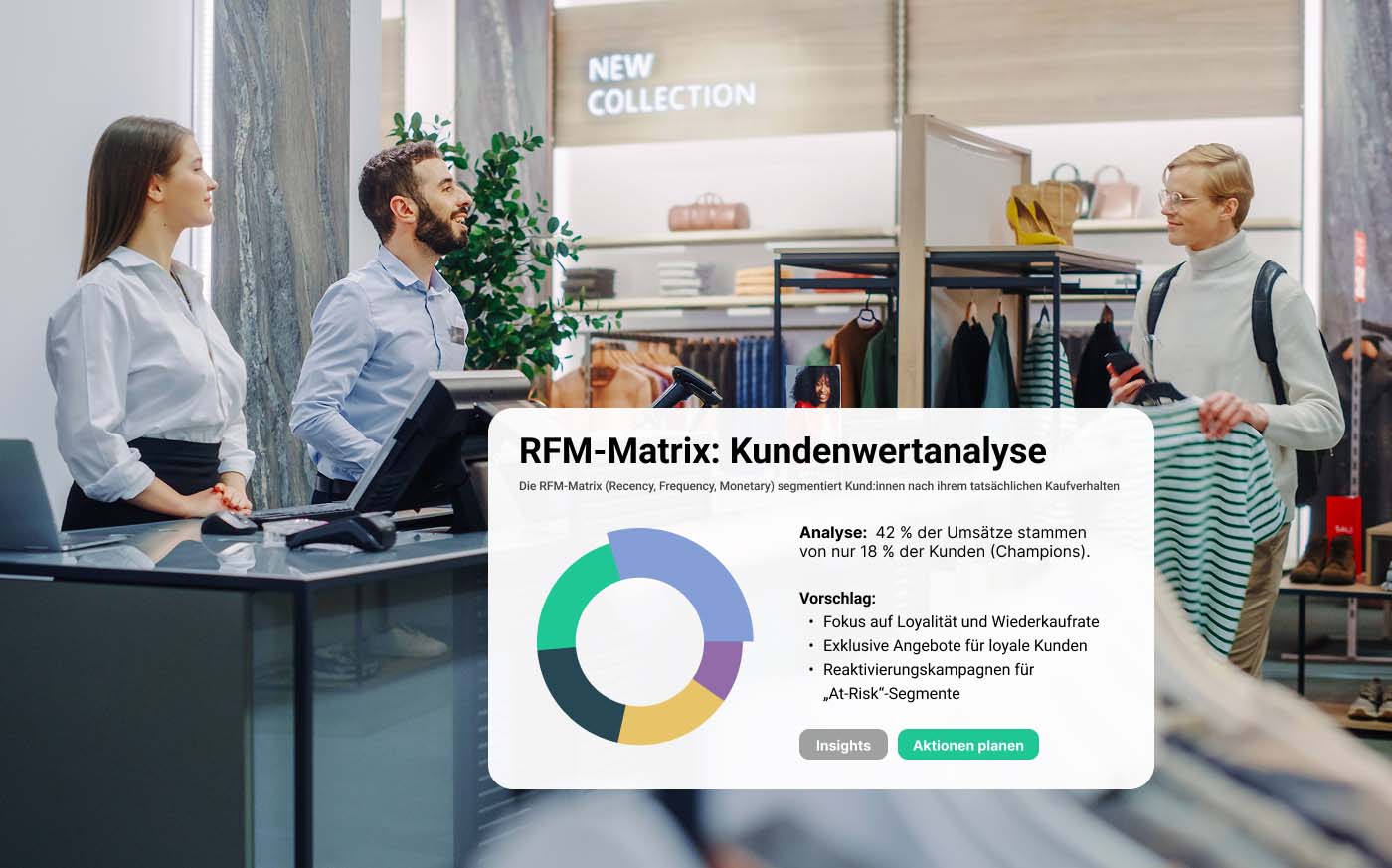
Every marketing manager knows the classic RFM analysis (Recency, Frequency, Monetary Value). But running it manually is time-consuming, and keeping it up to date is tedious. AI-supported systems automate this process – and go far beyond it.
What the AI delivers
Modern algorithms detect customer clusters automatically, based on actual purchasing behavior.
The decisive advantage: this segmentation is based on first-party data – information that retailers collect themselves.
3. Conversational analytics: talking to your data instead of reading reports
This is where AI becomes especially tangible: instead of operating complicated BI tools or waiting for reports from IT, employees simply ask questions in natural language.
Which products had the highest margin loss last week?
Show me the top sellers in the outdoor category for customers over 40.
How did revenue develop after our newsletter campaign?
What the AI delivers
Natural language processing (NLP) translates human questions into database queries and presents the results in an understandable way.
Practical example
A mid-market fashion retailer introduced a chat interface for its transaction data. Within three months, the number of data-based decisions in category management rose by 60 percent.
4. Sales forecasts: knowing today what will be ordered tomorrow
Predictive analytics is the classic among AI applications.
What the AI delivers
Machine learning models factor in historical sales data, weather, local events, public holidays, and price elasticities.
These systems do not replace planners – they support them with a better basis for decisions.
5. Automated recommendations: from insight to action
The biggest challenge in data analysis is not spotting patterns – it is acting on them.
What the AI delivers
Modern systems generate concrete recommendations for action:
Product X should be placed next to product Y; expected uplift: 12 percent.
Or: customer Z has not purchased in 45 days – recommended reactivation campaign: 10 percent off category A.
What doesn't work (yet)
Fully autonomous stores
Amazon Go and similar concepts make headlines, but their economic viability is questionable.
Fully automated price optimization
Dynamic pricing sounds tempting but is complex.
Precise customer identification without opt-in
Facial recognition is technically possible but highly problematic both socially and legally.
The real hurdles – and how to overcome them
Data access
The most valuable data sits in POS systems that are often hard to access.
Lack of expertise
No-code and low-code platforms lower the barrier to entry considerably.
Privacy uncertainty
Those who rely on first-party data and transparent consent are on solid legal ground.
ROI uncertainty
A pilot project with clear KPIs quickly delivers measurable results.
Quick wins: three actions for the next 30 days
Quick win 1: export and visualize transaction data
Effort: 1 to 2 days
Quick win 2: analyze your top 10 products at basket level
Effort: 4 to 8 hours
Quick win 3: identify customer frequency patterns
Effort: 2 to 3 hours
Conclusion: pragmatism beats perfectionism
AI in retail is not an all-or-nothing question. The most successful applications are the most pragmatic ones.
The most important first step is to ask:
Which decision am I making on gut feeling today that I could make based on data tomorrow?
The technology is mature. The data is there. All that is missing is the first step.
About Purchase Intelligence
anybill's Purchase Intelligence makes the use cases described in this article accessible to mid-market retailers – without a data science team and without months of implementation.
The platform turns transaction data into concrete recommendations that can be acted on immediately. Including a chat interface that makes querying data as easy as sending a text message.
Experience retail analytics in action:
Request a demo at anybill.de/demo
Weitere Blogbeiträge