How to understand what your customers are really buying
A customer buys diapers and then grabs the beer. Another takes pasta, tomatoes, and basil but forgets the olive oil. Identifying such patterns isn't magic, it's shopping cart analysis. A tool that is standard in e-commerce and is used far too rarely in stationary retail.
What is shopping cart analysis
Shopping basket analysis, called basket analysis or market basket analysis in English, examines which products customers buy together. The aim is to recognize patterns that are not visible at first glance.
The principle is simple. Each transaction at the checkout creates a data set. Customer X has currently purchased products A, B, and C. If you multiply that by thousands or millions of transactions, patterns are created. Product A is purchased with product B more than average. Customers who buy product C rarely use product D.
These findings are invaluable for product range design, shelf placement, cross-selling campaigns and personalized offers. Amazon has built an empire with it. The good news is that the same methods also work in brick-and-mortar retail.
Why is the topic relevant right now
Three developments make shopping basket analysis more attractive than ever for brick-and-mortar retailers.
Data availability
Modern cash register systems have long since collected all necessary data. The problem was never collection, but access. Middleware solutions make this data accessible today without replacing the existing IT infrastructure.
computing power
What used to require expensive special software and own servers is now running in the cloud. Data analysis costs have fallen by orders of magnitude.
competitive pressure
E-commerce providers know their customers better than ever before. Stationary retailers that don't catch up lose market share. Shopping basket analysis is a way to reduce the knowledge advantage.
An overview of the most important methods
There are various approaches to analyzing shopping carts. The three most important for retailers are the following.
Association analysis
The classic method. It identifies rules such as: When a customer buys product A, with a probability of X percent he also buys product B. The best-known algorithm for this is called Apriori, developed in the 1990s and is still the standard today.
Typical applications include cross-selling recommendations, product placement and bundle offers.
sequence analysis
An extension of association analysis that also takes order into account. Not just which products are bought together, but in which order they are purchased. This is particularly relevant for customer journeys over multiple visits.
Typical applications include reactivation campaigns, predicting the next purchase, and lifecycle marketing.
clustering
This is not about individual product pairs, but about customer groups. Which customers have similar shopping carts. The result is segments such as convenience buyers, family buyers or gourmet customers.
Typical applications include target group definition, personalized communication and product range planning by customer type.
The three key figures you need to know
If you want to understand shopping cart analysis, you need to know three terms: Support, Confidence and Lift. The math behind it is manageable.
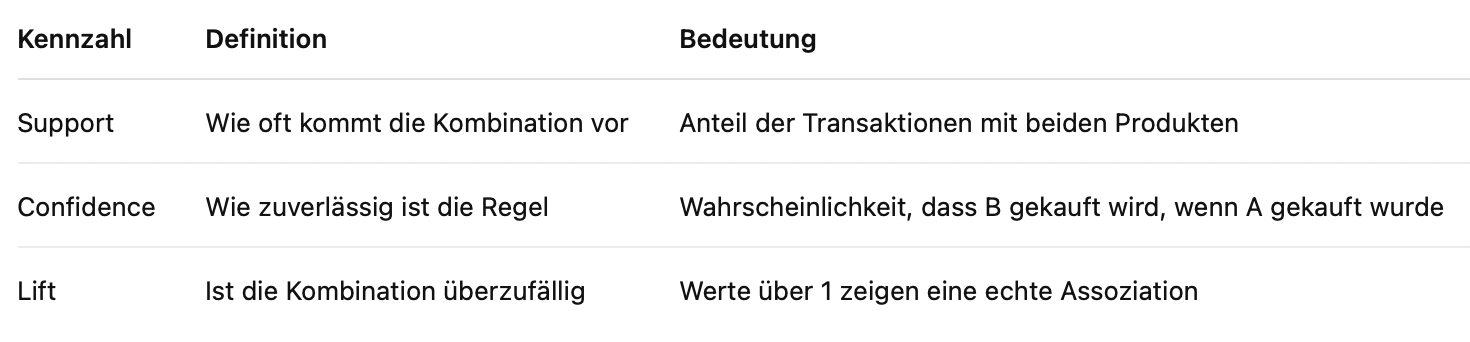
An example to illustrate is a hardware store where paint and brushes are analyzed. Support for paint and brushes accounts for 8 percent of all transactions. The confidence from paint to brush is 80 percent. The lift is 4.0, while brushes alone have a support of 20 percent.
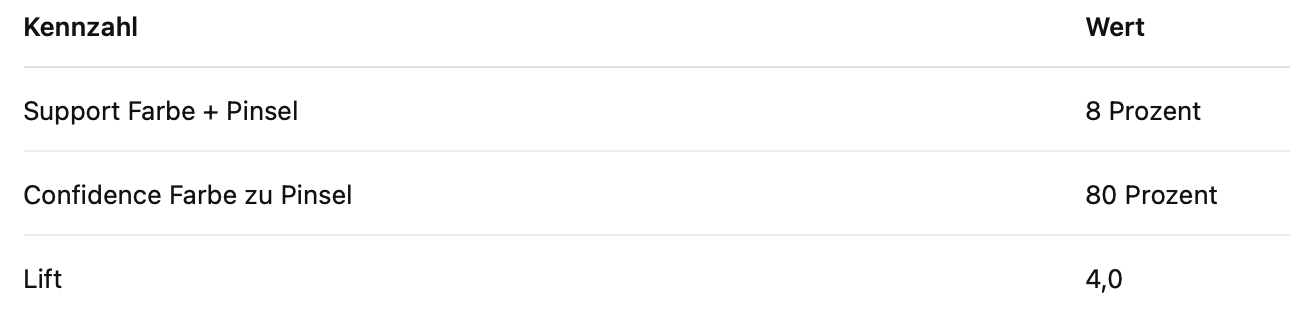
The interpretation is as follows. Paint and brush are purchased together in 8 percent of all transactions. Of all customers who buy paint, 80 percent also use a brush. The lift of 4.0 shows that this combination is four times more common than would be expected if the distribution was random. It is a strong association.
Practical examples from various industries
The shopping cart analysis works across industries. In food retailing, it is clear that customers who buy organic milk also use organic eggs and whole grain bread more often than average. Retailers then set up an organic corner in the market, which combines all three product groups. The result is a 15 percent higher average receipt among organic buyers.
In fashion retail, customers who buy jeans also buy a belt 35 percent of the time, but only if both products are available on the same day. A belt display right next to the jeans department and trained sales staff lead to a belt sales increase of 40 percent.
In the hardware store, customers who buy laminate often forget about footfall sound insulation. They come back later or buy them elsewhere. An automatic reminder on the digital receipt with a direct link to the online shop means that 25 percent of customers buy back the forgotten product.
In drugstores, buyers of hair dyes rarely buy hair treatments at the same time, although the combination would make professional sense. A bundle offering with a slight price advantage and staff training to provide advice double the cross-selling rate in this category.
Five mistakes you should avoid
Trivial relationships should not be overinterpreted. The fact that burger rolls and minced meat are bought together is not a real insight. Data bases that are too small lead to distorted results, as seasonal effects and actions distort the picture.
The lift should not be ignored. A high level of confidence alone is not meaningful if a product is bought frequently anyway. Similarly, correlation and causality should not be confused. Patterns are starting points for hypotheses, not certainties.
Finally, results should always be tested. A shopping cart analysis provides ideas, but no guarantees. Measures should first be tested in individual branches. A B tests are also possible in brick-and-mortar stores.
How to start a step by step guide
You don't have to be a data scientist to benefit from shopping cart analysis. Getting started starts with clarifying how to get your transaction data. For each transaction, you need a unique transaction ID, date and time, as well as all purchased items with an item number. Customer data is not absolutely necessary to get started.
The next step is to clean up the data. Returns, cancellations, and obvious outliers will be removed. Aggregation at product group level is recommended for very large product ranges.
Excel with pivot tables is sufficient for the analysis to get started. There are specialized tools for deeper analyses. A minimum support of 1 percent and a minimum confidence of 50 percent are useful starting points.
The results should be sorted by lift and trivial combinations filtered out. Focus on the top 10 to 20 unobvious associations.
Specific measures should be defined for each relevant association, such as a different shelf placement, bundle offers, training or digital recommendations. These measures should have measurable goals and should be tested first.
What tools do you need
The choice of tool depends on your resources and ambitions. Excel is free and well-known, but is only suitable for limited amounts of data and requires manual effort. BI tools offer visualization and dashboards, but require training and are often not retail-specific.
Retail analytics solutions are industry-specific, preconfigured and often integrated with POS systems, but involve ongoing costs and a certain vendor dependency. Individual code offers maximum flexibility and scalability, but requires developers and a high initial effort.
For most medium-sized retailers, a specialized retail analytics solution is the best compromise between a low barrier to entry and meaningful results.
Conclusion: The shopping cart as a treasure chest
Every transaction that passes through your cash registers contains valuable information. Shopping basket analysis makes it usable, not as an abstract analysis project, but as a practical tool for better product ranges, smarter placements and more relevant offers.
Getting started doesn't have to be complicated. Start with your top-selling products. Identify three to five connections that are not obvious. Test a measure and continue building from there.
You already have the data. The methods have been tried and tested. What is missing is the first step.
About Purchase Intelligence
Anybills Purchase Intelligence makes shopping basket analysis accessible to SMEs. The platform connects to your cash register system, automatically analyses transaction data and provides product affinities that you can implement directly. Without a data science team and without months of implementation.
Discover now. Request a demo at anybill.de/de/product/features/purchase-intelligence and see what potential lies dormant in your data.